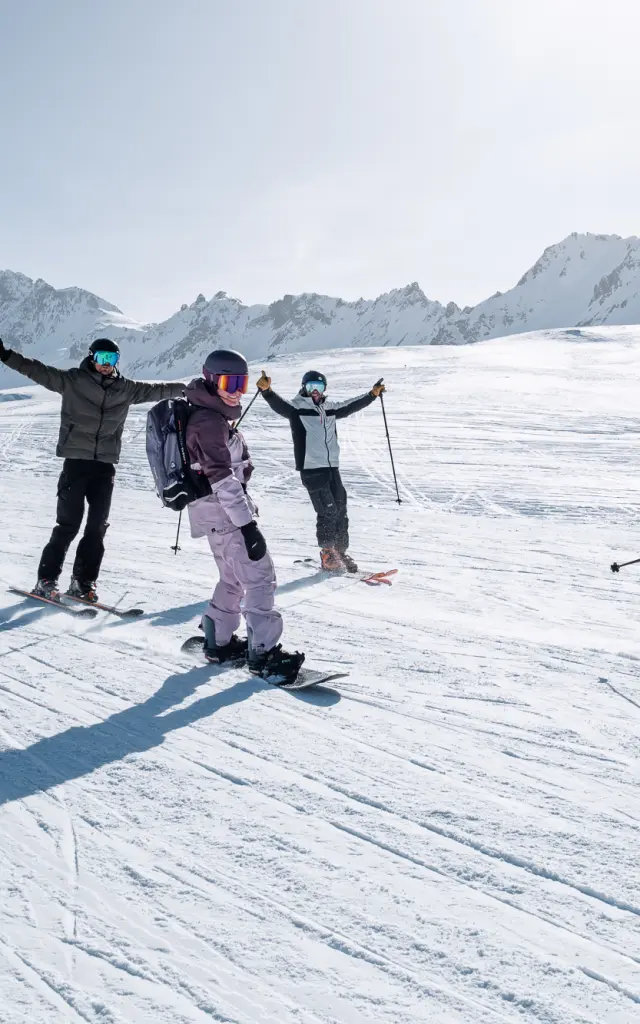
Off-piste snowboarder in Val d'Isère
©

Off-piste snowboarder in Val d'Isère

|

Elias Ejderhamn

Off-piste skiing #1 Safety first

Off-piste skiing is a rare experience, characterised by freedom, commitment and precision. It is an intense pleasure that must be approached with a methodical approach, humility and respect for the mountains. Before setting out on an untouched slope, there are a few basics to bear in mind to ensure you ski safely and make the most of the adventure.

The equipment for off-piste skiing

The trio essential

A successful off-piste outing always starts with the right equipment, which you know how to use. Every skier must carry the three essential items of avalanche safety equipment:

    • an avalanche transceiver
    • a sturdy shovel, ideally made of aluminium or stainless steel
    • a metal probe

This equipment enables you to quickly locate and dig out a person buried in an avalanche. But simply owning this equipment is not enough: it is essential to practise using it regularly so that you can act effectively on the day when every second counts. A few simple habits can help you get the most out of your equipment and save precious time in the event of an emergency:

    • Choose a reliable, high-performance avalanche transceiver (AV) with a wide search range to make it easier to locate a victim.
    • Always check the battery level before every outing: the charge level must be at least 90 per cent. High-quality batteries ensure a more reliable signal.
    • During a search, keep your mobile phone at least 30 cm away from the avalanche transceiver to avoid interference that could disrupt the signal.
    • Use the probe whilst wearing gloves: this protects your hands from the cold and prevents the probe from becoming covered in ice, which could make it difficult or impossible to use.

For staff working at the Val d’Isère resort, it is possible to borrow equipment (avalanche transceiver, shovel, probe) from the Vie Val d’Is Association. All you need to do is complete an avalanche safety course and hold a season pass.

The airbag bag additional security

More and more off-piste skiers are also using an avalanche airbag rucksack. This specialised rucksack is fitted with an inflatable airbag system that is triggered by pulling a handle in the event of an avalanche.

The principle is simple: by increasing the skier’s volume, the airbag helps them stay on the surface of the avalanche, which significantly reduces the risk of being completely buried.

Althoughit can never replace the trio of avalanche transceiver, shovel and probe, the airbag rucksack is now a highly recommended piece of safety equipment for off-piste skiing.

Recommended essentials to pack

To complete your kit, we recommend that you pack the following in your bag:

    • a fully charged mobile phone
    • a first-aid kit
    • a survival blanket
    • warm gloves
    • a face mask or sunglasses
    • something to drink and eat
    • a small kit for repairing equipment

In the mountains, self-reliance and planning ahead often make all the difference.

The right thing to do off-piste

Safety when off-piste depends as much on the equipment as it does on the group’s behaviour and good practice in the field. Before setting off, it is essential to:

    • be aware of the ability levels of everyone in the group
    • check the weather forecast and avalanche risk (link to article 2)
    • check that everyone’s avalanche transceivers are working properly

In the mountains, collective vigilance is paramount. During the descent:

    • maintain safe distances between skiers
    • group together only in sheltered areas
    • keep an eye on one another

It is also important to know how to alert the emergency services if necessary.

Choosing your range Analysing risk factors

Risk factors

Before setting off down an off-piste slope, it is essential to take the time to assess the situation. Choosing a route should never be based solely on the desire to ski a beautiful slope: it must be based on a careful assessment of the surroundings and the current conditions.

To structure this assessment, many mountain professionals use the 3×3 method developed by the Swiss guide Werner Munter. This approach, now widely adopted in mountain sports, enables the risk of avalanches to be assessed in a simple and logical way, based on three main factors:

    • Conditions: recent weather, snowfall, wind, temperatures or the forecast avalanche risk level.
    • Terrain: slope gradient, aspect, presence of rocky outcrops, areas of snow accumulation or distinctive landforms.
    • The human factor: the group’s technical ability, off-piste experience, fatigue or group pressure.

Key moments

These three elements must be observed at three key stages of the release, which is where the method gets its name:

    1. During preparation (regional level)
      Before setting off, you should check the available information: weather forecast, avalanche bulletin, snowpack conditions and route selection.
    1. During the approach (local level)
      Once in the mountains, it is important to compare actual conditions with the forecast: wind, snow accumulation, signs of recent avalanches or the behaviour of the snowpack.
    1. On the slope (zonal level)
      When you’re about to set off, you must ask yourself the crucial question:“Do the conditions really allow me to go ahead?”
      If the answer is yes, you still need to consider how to tackle the slope: spacing between skiers, safe stopping areas, and the descent route.

The strength of the 3×3 method lies in its simplicity: it relies more on observation, common sense and experience than on complex calculations. Above all, it helps you ask the right questions at the right time.

And sometimes, the best decision is simply to turn back. In the mountains, knowing when to turn back is an integral part of off-piste skiing.

The 3x3 method Matrix

Risk analysisConditionsLandGroup
House or mountain hutSnow report

Automatic weather stations

Typical avalanche situations

Latest updates from guides or social media

Maps, route guides

Opening times, gradients, aspect

Scenarios to avoid

Group size

Experience, ability

Responsibility, expectations

Choice of abseiling method

During the approachWeather (wind, temperature, precipitation)

Critical amount of fresh snow

Warning signs

Comparison of map and terrain

Traffic, tracks

The group’s fitness level

Changes in the group’s composition

Avalanche transceiver check

Checking the timetable

On the slopeVisibility, weather

Warming up, hydration

Critical amount of fresh snow

Warning signs

Trail conditions, terrain configuration

Actual slope angle and aspect

Other objective hazards

Fitness, motivation, discipline

Time management

Adherence to safety distances

Descent corridor

Discover the village of Val d'Isère in winter

Val d’Isère is committed to preserving its authentic, pioneering spirit and offering you a genuine mountain experience.